Fine-Tuning vs RAG: A Decision Guide for Teams Without ML Engineers
RAG feeds your documents to a model at question time. Fine-tuning retrains the model on your examples. For most teams without ML engineers, RAG wins. It costs a few hundred dollars a month, ships in two weeks, and updates by replacing a file. Fine-tune only for fixed tone or format.
This guide covers how each approach actually works, real dollar costs for both, a five-question decision tree, and a lean RAG architecture you can realistically ship without a dedicated ML hire.
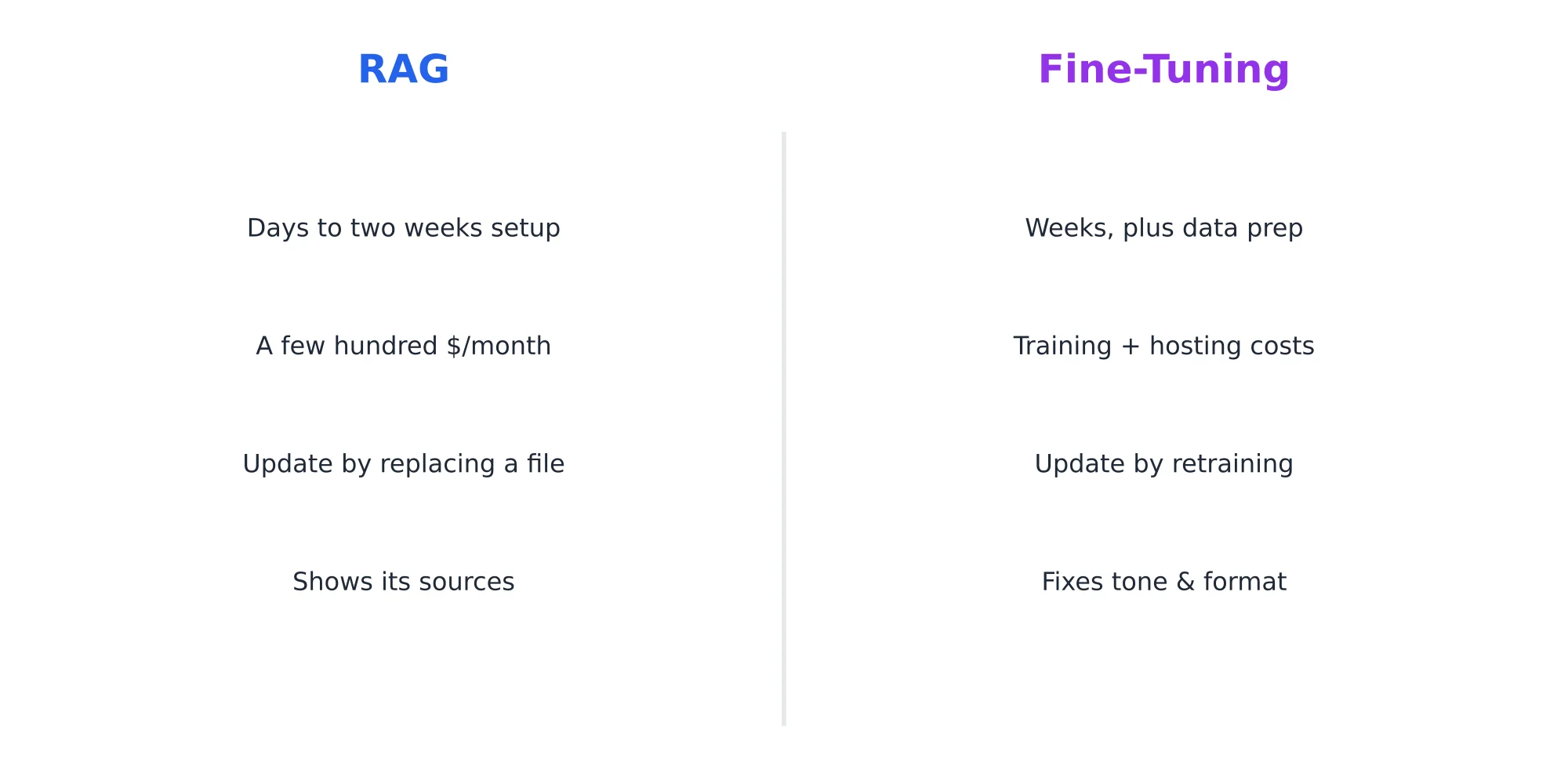
Fine-Tuning vs RAG, in One Table
| RAG | Fine-Tuning | |
|---|---|---|
| Setup time | Days to two weeks | Weeks, plus data prep |
| Monthly cost | A few hundred dollars typically | Training cost plus hosting or per-token fees |
| Updating knowledge | Replace or add a document | Retrain the model |
| Best for | Knowledge that changes often, needs citations | Fixed tone, format, or narrow repeated tasks |
| ML expertise needed | Low, with managed services | Moderate to high |
What Is RAG, and How Does It Work?
RAG (retrieval-augmented generation) retrieves relevant chunks of your documents at question time, adds them into the model’s prompt, then lets the model answer using that retrieved context. A vector database stores your documents as searchable embeddings, though for a smaller document set a simple search index can substitute entirely — you don’t always need a dedicated vector database to start. RAG meaningfully cuts hallucinations because the model is answering from supplied text rather than relying purely on its training data, and it can show its sources directly, which a fine-tuned model generally cannot do.
RAG is weaker at tasks requiring a fixed, consistent output format or tone across every response, since it’s adding facts to a general-purpose model rather than reshaping how that model fundamentally responds.
What Is Fine-Tuning, and How Does It Work?
Fine-tuning retrains part of a model’s weights on your own example data, teaching it a specific style, format, or narrow task pattern rather than new facts. LoRA and similar lightweight methods fine-tune a small subset of the model’s parameters at a fraction of full fine-tuning’s cost, and are the realistic starting point for a team without dedicated ML infrastructure. Fine-tuning generally needs hundreds of well-constructed examples at minimum to produce a reliable result.
Fine-tuning is particularly bad at teaching a model new facts reliably — it tends to blend new information with existing patterns in ways that reintroduce the exact hallucination risk you were trying to fix.
Try Prompt Engineering First
Before building either RAG or a fine-tuning pipeline, test whether a carefully written prompt with a few examples already solves the problem — a surprising share of use cases that seem to need RAG or fine-tuning are actually solvable with better prompting alone, at zero infrastructure cost.
The Real Dollar Cost of RAG
A realistic monthly bill for a 20-person company running RAG typically includes embedding costs (usually a modest one-time or incremental fee), a managed vector database or search index subscription, and per-query token costs that run higher than a plain chatbot since RAG prompts include the retrieved context alongside the question. All together, this commonly lands in the low hundreds of dollars per month for moderate query volume.
The Real Dollar Cost of Fine-Tuning
A single training run on a hosted fine-tuning API typically costs less than most teams expect for the compute itself, but the hidden cost is almost always data labeling and cleanup hours — preparing several hundred quality training examples takes real time from someone who understands the task well. Hosting a fine-tuned model afterward costs more per month than paying per-token for a general model, unless your call volume is very high. Retraining whenever your underlying data changes repeats most of this cost each time.
When to Use RAG
- Your knowledge base changes weekly or faster
- You need citations users can click through to verify
- You have documents available but not hundreds of labeled training examples
When to Use Fine-Tuning
- You need a genuinely fixed tone, format, or output shape across every response
- You run millions of short, repetitive calls where per-token savings compound meaningfully
- The model keeps failing one narrow, specific task you can clearly demonstrate with examples
When to Use Both Together
A realistic hybrid fine-tunes the model’s style and tone while RAG handles retrieving the specific facts — letting each approach do the job it’s actually good at. Hybrid setups add real complexity, though, and are the wrong place to start for a team without existing ML infrastructure; get RAG working well on its own first.
A Lean RAG Architecture You Can Ship in Two Weeks
Five components cover a minimal working system: your documents, a chunking step that splits them into retrievable pieces, an embedding model that converts chunks into searchable vectors, a storage layer (a managed vector database, or even a simple file-based index for a small document set), and the language model itself answering from retrieved context. Managed services for each of these pieces exist specifically to replace the need for a dedicated ML hire. Start with reasonable defaults for chunk size and retrieval count rather than optimizing prematurely — add complexity only after real users surface specific problems.
Who Owns This After Launch?
RAG needs a weekly job re-indexing new or changed documents and a monthly check of bad answers to fix problematic chunks — a modest, sustainable ongoing load most non-technical team members can own with basic training. Fine-tuning’s ongoing maintenance load is less frequent but heavier per cycle, since any meaningful data change requires a full retraining pass rather than a quick document swap.
How to Tell If It’s Working
Build a test set of 50 real questions your system should be able to answer correctly, and track three outcomes for each: right, wrong, and “I don’t know.” A system that confidently gives wrong answers is worse than one that honestly says it doesn’t know — tune your prompt and retrieval settings specifically to favor that safer failure mode.
Decision Tree: Pick Your Path in Five Questions
- Does your answer genuinely depend on specific documents, or is it a general writing or formatting task?
- How often does that underlying content actually change?
- Do you have 500 or more quality example answers already, or would you need to create them from scratch?
- What’s your realistic monthly budget for this?
- Who will actually own and maintain this in six months?
Five Ways Teams Waste Money on This Choice
- Fine-tuning specifically to teach the model new facts, which doesn’t reliably work
- Buying a dedicated vector database subscription for a document set small enough for simple search
- Hiring an ML engineer before proving the underlying use case actually works at a small scale
Your First 30 Days
Week 1: pick 20 real questions and baseline how the plain model answers them without any RAG or fine-tuning. Week 2: ship the smallest working RAG version you can build. Weeks 3 and 4: measure real results against your test set, fix problematic chunks, and only then decide whether fine-tuning is actually worth adding.