AI Accuracy vs Reliability: How to Vet an AI Vendor Before You Buy
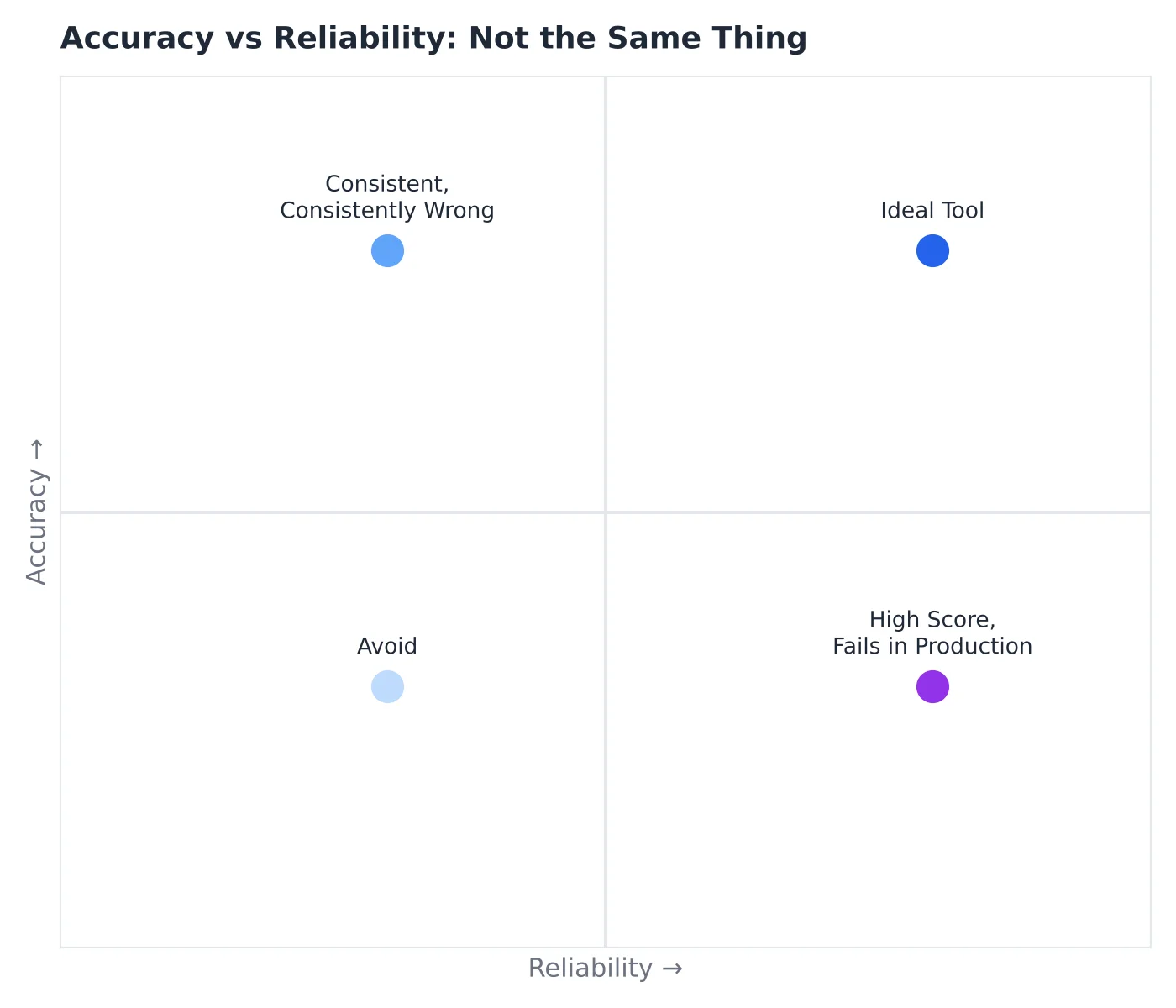
AI accuracy measures how often a model’s output is correct on test data. AI reliability measures whether it performs consistently in real-world use, across edge cases, over time. A tool can score high on accuracy benchmarks yet fail unpredictably in production. Before buying, test both separately using your own data, not vendor demos.
This guide explains the real difference between the two, the metrics that actually show each one, and gives you a vendor vetting checklist to test any AI tool’s claims before you sign a contract.
What “AI Accuracy” Actually Means
Accuracy measures how often a model’s output matches the correct answer on a specific test dataset — a single number calculated under controlled conditions that may not resemble your actual use case at all.
What “AI Reliability” Actually Means
Reliability measures whether that same model keeps performing consistently once it’s handling real inputs, unusual edge cases, and sustained use over time, rather than the clean benchmark data it was scored against.
The Key Difference, in One Sentence
Accuracy tells you how the model performed on one test; reliability tells you whether you can trust it to perform that way consistently once it’s actually deployed on your own real-world inputs.
| AI Accuracy | AI Reliability | |
|---|---|---|
| What it measures | Correctness on a test dataset | Consistency in real-world use over time |
| Measured when | Once, at benchmark time | Continuously, after deployment |
| Vendor headline metric | Yes, almost always | Rarely disclosed upfront |
| Fails when | Test data doesn’t match real inputs | Inputs drift or edge cases pile up |
| How to verify | Run it on your own labeled data | Monitor it in production over weeks |
Why Vendors Only Talk About Accuracy
A single accuracy percentage is simple to market and easy to compare across competitors, while reliability requires ongoing measurement across time and conditions that don’t fit neatly into one headline number on a sales page.
Why High Accuracy Scores Still Fail in Real-World Use
A model benchmarked on clean, well-formatted test data can degrade sharply on messier real inputs, edge cases the benchmark didn’t include, or inputs that drift from the original training distribution over time — none of which a single accuracy number captures.
Software Reliability vs AI Reliability: What’s Different
Traditional software reliability is largely deterministic — the same input produces the same output every time, and bugs are generally fixable once found. AI reliability is probabilistic: the same input can produce subtly different outputs across runs, and a model can drift in performance over time as the real-world data it encounters shifts away from its original training data, without any code actually changing.
The Business Risk of Confusing Accuracy with Truth
Real-World Cases Where This Went Wrong
Several widely reported cases involve companies deploying an AI tool that scored well on vendor benchmarks, only to find it producing confidently wrong outputs in production that went unnoticed until a customer or regulator caught the error — the gap between benchmark accuracy and real-world reliability is where that risk consistently lives.
The Metrics That Actually Show Accuracy
Precision, Recall, and F1 Score, Explained Simply
Precision measures how many of the model’s positive predictions were actually correct. Recall measures how many of the actual positive cases the model successfully caught. F1 score balances the two into a single number, useful when you care about both false positives and false negatives roughly equally.
Hallucination Rate and Error Rate
Hallucination rate measures how often a model generates confident, specific-sounding but factually wrong output — a particularly important metric for any generative AI tool, since a confident wrong answer is more dangerous than an obviously uncertain one.
The Metrics That Actually Show Reliability
- Consistency across repeated runs. Does the same input reliably produce a similar output, or does it vary significantly run to run?
- Latency and uptime under load. Does performance hold steady during peak usage, or degrade?
- Performance drift over time. Does accuracy quietly decline as real-world data shifts away from the original training distribution?
The Pre-Purchase Vendor Vetting Checklist
- Ask for accuracy numbers measured on data resembling your actual use case, not the vendor’s own benchmark
- Ask how reliability is measured over time, not just at a single point of initial testing
- Ask for raw failure examples, not just an aggregate success rate
- Request a live demo using your own real data, not the vendor’s prepared sales demo dataset
Red flags in a vendor’s accuracy claims include a single impressive percentage with no disclosed test methodology, and unwillingness to let you test on your own real data before signing a contract.
How to Test Accuracy and Reliability Yourself
Run a structured pilot using your own real data rather than relying on the vendor’s demo environment, and set a clear pass/fail threshold before you start testing — deciding success criteria after seeing results invites bias toward whatever the tool happens to be good at. Stress-test specifically with edge cases and unusual or adversarial inputs, since these are exactly what a polished vendor demo is designed to avoid showing you.
What to Put in the Contract or SLA
Push for explicit accuracy and uptime guarantees tied to your own test criteria, not the vendor’s generic marketing numbers, and negotiate audit rights that let you independently verify performance on an ongoing basis after deployment, not just at initial purchase.
The Human-in-the-Loop Ingredient Vendors Won’t Mention
Nearly every reliable production AI deployment includes a human review step for higher-stakes outputs — a detail vendor sales materials tend to downplay since it implies the tool isn’t fully autonomous. Budget for this review step as a real, ongoing cost rather than treating full automation as the default expectation.
Why Explainability Matters for Trust
Understanding why a model produced a specific output matters beyond pure compliance requirements — it’s what lets your team catch a systematically wrong pattern before it causes real damage, rather than discovering the problem only after a customer complaint.
Data Quality and Domain Expertise to Check
Ask what data the vendor’s model was actually trained on, and whether that training data genuinely resembles your specific industry and use case — a model trained predominantly on general web data can underperform significantly on specialized domain language and edge cases.
Security, Ethics, and Compliance Checks
Confirm the vendor’s data handling practices, whether your input data trains their shared models, and what compliance certifications actually apply to your specific regulatory requirements before signing — a general security badge doesn’t automatically cover every regulation relevant to your industry.
Common Pitfalls That Skew Accuracy and Reliability Claims
Cherry-picked test sets, benchmarks run on data that doesn’t reflect real-world conditions, and accuracy numbers reported without any confidence interval or sample size disclosed are the most common ways a vendor’s claimed numbers end up misleading.
Monitoring After You Buy
Set up ongoing monitoring of real production accuracy and reliability after deployment rather than treating the initial pilot as a one-time check — performance drift happens gradually and is easy to miss without continuous measurement.
A Quick Reference Vetting Checklist
- Accuracy tested on your own data, not vendor benchmarks
- Reliability measured over time, not just at a single point
- Raw failure examples requested and reviewed
- Edge cases and adversarial inputs stress-tested
- Contract includes accuracy and uptime guarantees tied to your criteria
- Ongoing monitoring plan in place after deployment